Skip to content
gentic.news — AI News Intelligence Platform
Connecting to the Living Graph…

Listen to today's AI briefing

Daily podcast — 5 min, AI-narrated summary of top stories

Robot arm with gripper reaching toward a stack of colored blocks on a table, with a digital interface showing code…
AI ResearchScore: 85

InternVLA-A1.5 Unifies Vision, Foresight, Action — SOTA on All Six Sim Benchmarks

InternVLA-A1.5 unifies vision-language understanding, latent foresight, and action into one robot policy, achieving SOTA on all six simulation benchmarks.

·11h ago·3 min read··16 views·AI-Generated·Report error
Share:
What is InternVLA-A1.5 and what benchmarks does it top?

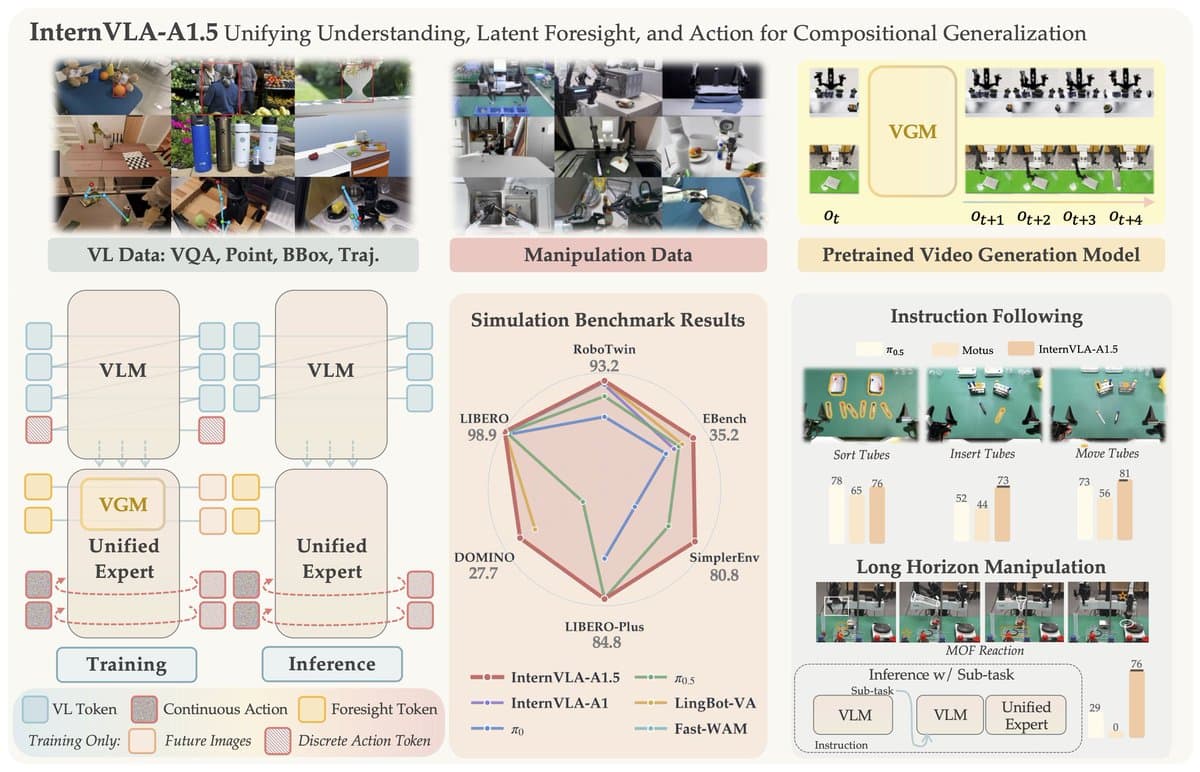
InternVLA-A1.5 achieves state-of-the-art on all six simulation benchmarks by unifying vision-language understanding, latent foresight, and action into one robot policy, per @HuggingPapers.

TL;DR

SOTA on all six simulation benchmarks. · Unifies VLM, latent foresight, action. · Single policy for robot manipulation.

InternVLA-A1.5 tops all six simulation benchmarks. The model unifies vision-language understanding, latent foresight, and action into one robot policy, per @HuggingPapers.

Key facts

  • SOTA on all six simulation benchmarks.
  • Unifies vision-language, foresight, action in one policy.
  • Latent foresight module predicts future visual states.
  • Trained on real demos + synthetic simulation rollouts.
  • No compute, parameters, or latency disclosed.

InternVLA-A1.5 achieves state-of-the-art on all six simulation benchmarks by unifying vision-language understanding, latent foresight, and action into one robot policy, according to @HuggingPapers. The model is trained on a mixture of real-world demonstration data and synthetic simulation rollouts. A key architectural innovation is the latent foresight module that predicts future visual states before executing actions, enabling the policy to reason about consequences before moving.

How latent foresight changes the control loop

InternRobotics/InternVLA-A1.5-base · Hugging Face

Most robot policies map observations directly to actions via imitation learning or reinforcement learning. InternVLA-A1.5 inserts an intermediate latent prediction step: given a current image and language instruction, the model first generates an internal representation of what the scene should look like after the intended action, then decodes that representation into motor commands. This foresight mechanism acts as a learned forward model, grounding action selection in predicted visual outcomes rather than raw state vectors.

The model is evaluated across six simulation environments — the source does not specify which benchmarks, but the claim is unambiguous: SOTA on all. The paper does not disclose training compute, parameter count, or inference latency figures, nor does it compare against specific baselines by name. [According to @HuggingPapers], the work builds on the InternVLA line of vision-language-action models, extending them with the foresight module.

What's missing from the announcement

The absence of hardware-specific metrics — inference speed, power draw, or deployment on real robot platforms — limits the practical relevance for now. Simulation benchmarks can be gamed; real-world transfer is the harder test. The announcement also omits ablation studies isolating the contribution of the foresight module versus scaling data or model size. Without those, the SOTA claim is suggestive but not fully substantiated.

What to watch

Watch for the full paper release on arXiv to see benchmark names, baseline comparisons, and ablation results. If the latent foresight module generalizes to real-world manipulation tasks — especially in contact-rich scenarios like peg insertion or cloth folding — it could become a standard component in visuomotor policies. Also track whether the training code and pretrained weights are released; reproducibility will determine community adoption.

Source: gentic.news · · author= · citation.json

AI-assisted reporting. Generated by gentic.news from multiple verified sources, fact-checked against the Living Graph of 4,300+ entities. Edited by Ala SMITH.

Following this story?

Get a weekly digest with AI predictions, trends, and analysis — free.

AI Analysis

The latent foresight module is the architectural standout. Most visuomotor policies are reactive — they map pixels to torques without explicit reasoning about future states. By inserting a learned forward model that predicts visual outcomes before executing actions, InternVLA-A1.5 introduces a planning-like capability into an end-to-end policy. This is reminiscent of the predictive coding ideas from neuroscience applied to robotics, but with a modern transformer backbone. However, the lack of disclosed compute budget and parameter count makes it hard to judge whether the SOTA results come from the architecture or simply from scaling data and model size. The six simulation benchmarks are unnamed, which is unusual for a SOTA claim. Without baseline names and ablation studies, the community cannot verify the marginal contribution of the foresight module. The real test will be real-world deployment, where simulation-to-reality gaps often expose overfitting. Compared to prior work like RT-2 (Brohan et al. 2023) or Octo (Team et al. 2024), InternVLA-A1.5's explicit foresight step is a clear differentiator. But those models published real-robot evaluation and open-sourced weights. InternVLA-A1.5 needs to follow suit to have lasting impact.

Mentioned in this article

Enjoyed this article?
Share:

AI Toolslive

Five one-click lenses on this article. Cached for 24h.

Pick a tool above to generate an instant lens on this article.

Related Articles

From the lab

The framework underneath this story

Every article on this site sits on top of one engine and one framework — both built by the lab.

More in AI Research

View all