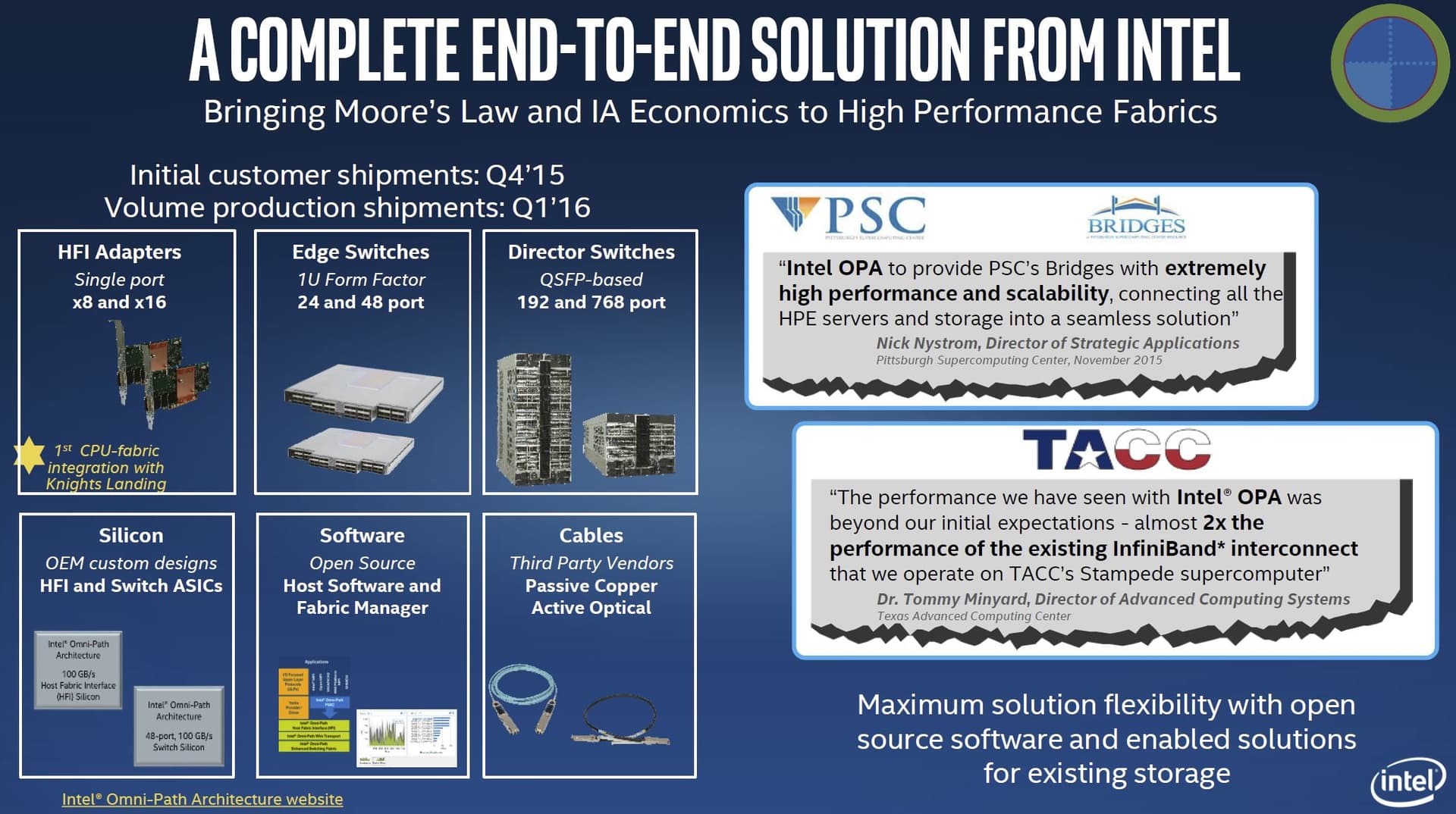
Intel's Omni-Path interconnect, revived by Cornelis Networks, will connect U.S. Department of Energy supercomputers as a 400Gbps alternative to Nvidia's InfiniBand, The Register reports. The technology, originally developed in-house at Intel, resurfaces after Intel abandoned it in 2019 due to market share losses.
Key facts
- Cornelis CN5000 switch: 200 ports at 400Gbps
- Latency under 100 nanoseconds per hop
- Intel discontinued Omni-Path in 2019
- DoE deployment covers 2027-2028 exascale systems
- Cornelis raised $45M Series B since spinoff
Intel's Omni-Path interconnect technology, originally developed for HPC clusters, is being revived by Cornelis Networks as a 400Gbps fabric for U.S. Department of Energy supercomputers, The Register reports. The Cornelis CN5000 switch supports up to 200 ports of 400Gbps Omni-Path, with latency under 100 nanoseconds, per the company's specifications. This deployment marks the first major win for Omni-Path since Intel discontinued its own Omni-Path products in 2019 after failing to gain market share against InfiniBand, which is now owned by Nvidia following its 2020 acquisition of Mellanox.
Omni-Path uses a direct-memory-access model that avoids the TCP/IP stack overhead, achieving sub-microsecond latency and 90%+ bandwidth utilization in benchmark tests, according to Cornelis. The technology competes directly with Nvidia's InfiniBand NDR 400 (400Gbps) and the emerging Ultra Ethernet Consortium, backed by AMD, Intel, and others. The DoE's choice of Omni-Path signals a desire to diversify away from Nvidia's dominant networking stack, which powers most Top500 supercomputers.
Why This Matters for AI Training
For AI engineers, Omni-Path's revival offers an alternative interconnect for large-scale distributed training, where InfiniBand's RDMA (Remote Direct Memory Access) has been the de facto standard. The Cornelis CN5000's 400Gbps per-port bandwidth matches InfiniBand NDR-400, but Omni-Path claims lower tail latency, which is critical for all-reduce operations in model-parallel training. However, adoption will depend on software ecosystem maturity — Omni-Path requires custom drivers and MPI libraries, whereas InfiniBand benefits from Nvidia's CUDA-Aware MPI and NCCL optimizations.
Cornelis Networks has not disclosed pricing or volume commitments from the DoE. The company, spun out of Intel in 2021, has raised $45 million in Series B funding, according to Crunchbase. The DoE deployment timeline remains unspecified, but The Register notes the contract covers multiple exascale-class systems planned for 2027-2028.
What to watch
Watch for Cornelis Networks' next funding round or IPO filing, which would signal commercial traction beyond DoE. Also track Ultra Ethernet Consortium adoption — if it gains momentum, Omni-Path could face a third competitor in the HPC interconnect market by 2028.
Source: news.google.com