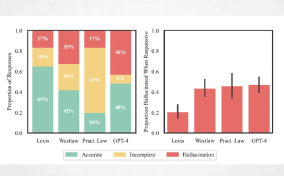
Stanford researchers found that law professors preferred AI answers over peer professor answers 75% of the time when judging legal analysis. The blind evaluation, reported by @rohanpaul_ai, suggests AI can outperform human experts in specific legal reasoning tasks.
Key facts
- 75% preference rate for AI over human professor answers.
- Blind evaluation design with unknown source to raters.
- Study by Stanford researchers, reported via @rohanpaul_ai.
- AI model and sample size not disclosed in initial report.
- Legal reasoning task, specific topics not specified.
Stanford researchers found that law professors preferred AI answers over peer professor answers 75% of the time when judging legal analysis According to @rohanpaul_ai. The blind evaluation involved professors rating answers without knowing the source, with AI-generated responses preferred in three out of four cases.
This result signals a potential shift in how legal expertise is assessed. If AI can consistently produce answers that experts prefer over those from human peers, it challenges assumptions about the unique value of human judgment in law. However, the study's methodology—sample size, question types, and the specific AI model used—remains undisclosed, limiting direct comparison to prior work.
Previous research, such as Choi et al. 2023 on GPT-4 passing the bar exam, showed AI can achieve high scores on standardized legal tests. This study goes further by testing expert preference in open-ended reasoning, a more subjective metric. The 75% figure is striking but requires replication with transparent methods.
The finding also raises practical questions: Will law firms adopt AI for drafting briefs? Can AI serve as a reliable second opinion in legal analysis? The preference gap suggests potential for AI-assisted legal work, but ethical and accuracy concerns remain.
What the study doesn't say
The source tweet provides no details on the AI model, number of participants, or specific legal topics tested. Without these, the result is suggestive but not conclusive. The 75% preference could reflect AI's ability to produce polished, formulaic answers rather than deeper legal reasoning.
Implications for legal AI
If confirmed, this study would join a growing body of evidence that AI can perform specialized professional tasks at or above human levels. For law, it could accelerate adoption of AI tools for document review, draft generation, and even client advice. However, the bar for accuracy and liability in legal work is high—preference is not the same as correctness.
What to watch
Watch for the full paper or preprint release with methodology details—sample size, model used, and question types. If replication studies confirm the 75% preference rate, expect rapid integration of AI into legal workflows and new benchmarks for professional AI evaluation.