Nvidia has spent more than $6.5 billion securing photonics supply since March 2026, making a calculated bet that optical interconnects — not GPUs or memory — will determine who wins the next phase of the AI infrastructure race.
The campaign began on March 2, when Nvidia announced simultaneous $2 billion strategic investments in Coherent Corp. and Lumentum, each paired with multi-billion-dollar purchase commitments and future capacity rights. Subsequent deals added $2 billion in Marvell and up to $500 million in Corning, bringing the disclosed total to at least $6.5 billion. Nvidia last raised debt in 2021; the $25 billion bond sale it completed on June 16 — upsized from a $20 billion target on $85 billion of orders — provides the capital headroom to fund these commitments alongside general operations.
Key Takeaways
- Nvidia has invested over $6.5 billion across four photonics suppliers since March 2026, pairing equity stakes with multi-billion-dollar purchase commitments.
- The deals coincide with capacity expansion announcements from Coherent, Nokia, and Japan's JX Advanced Metals, and signal that optical interco.
Why Light Is Replacing Copper

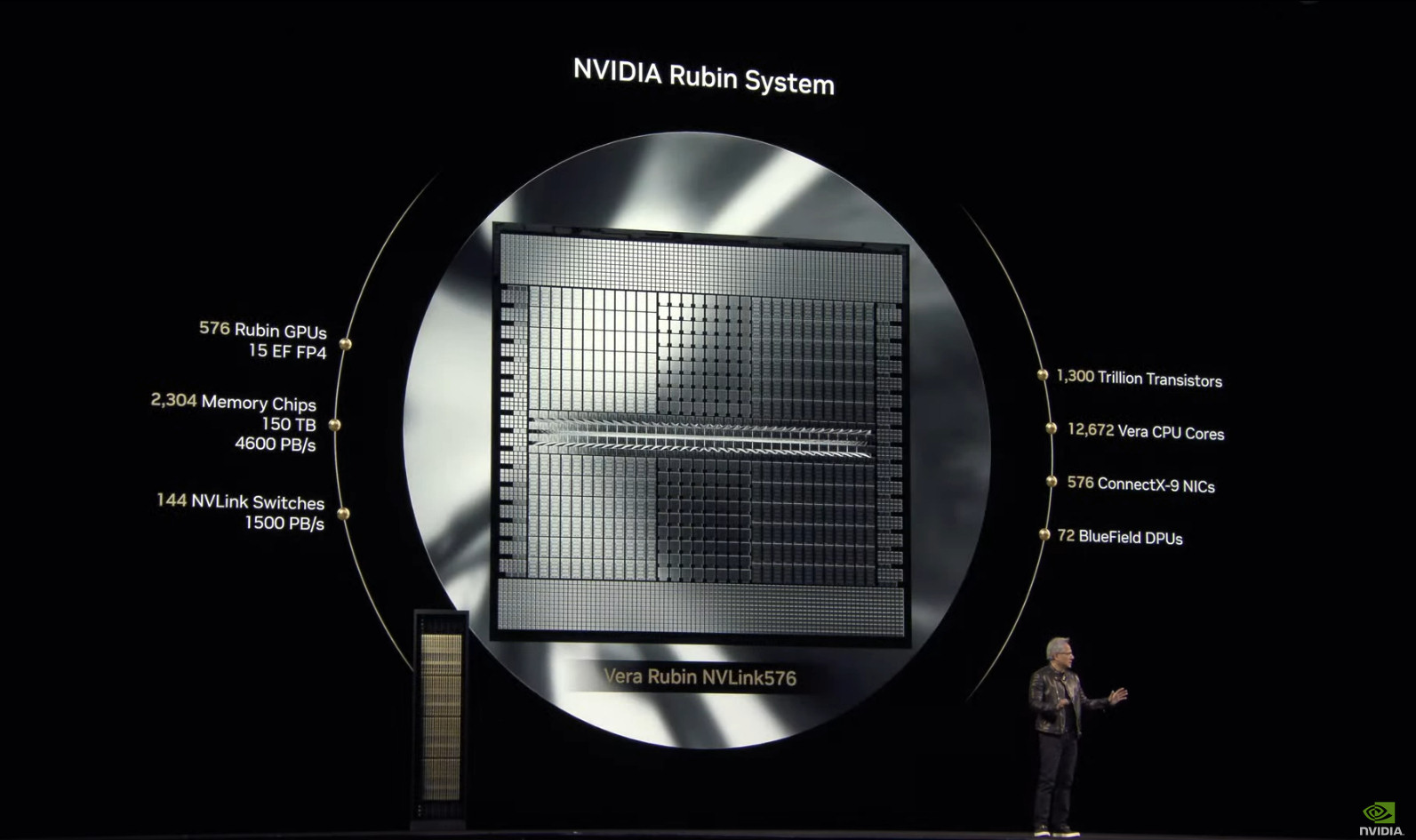
The physics of scale are forcing the issue. Nvidia's current Blackwell platform uses NVLink-C2C at 1.8 TB/s to couple GPUs within a server node. Its incoming Vera Rubin platform, unveiled at CES 2026, doubles that to NVLink 6 at 3.6 TB/s per GPU for in-rack connections. But connecting thousands of racks across a data center at those bandwidths is where copper fails: signal attenuation, power draw, and thermal density all compound at distance.
Nvidia's answer for Vera Rubin is co-packaged optics (CPO) on its scale-out Spectrum-X Ethernet switching platform, which the company says delivers five times better power efficiency than plug-in optical modules. The more decisive shift comes with Feynman, the generation following Rubin planned for around 2028, which will feature NVLink switches with integrated CPO — enabling all-to-all optical communication across clusters of up to 1,152 GPUs treated as a single computational domain.
'When you look upstream, you come to the conclusion that we are starting to scale our silicon photonics technology,' Jensen Huang said at GTC in March. 'The amount of silicon photonics technology capacity that we need is substantially higher than the world has today.'
The Supply Chain Scrambling to Catch Up
Nvidia's purchase commitments are already reorganizing the optical component industry.
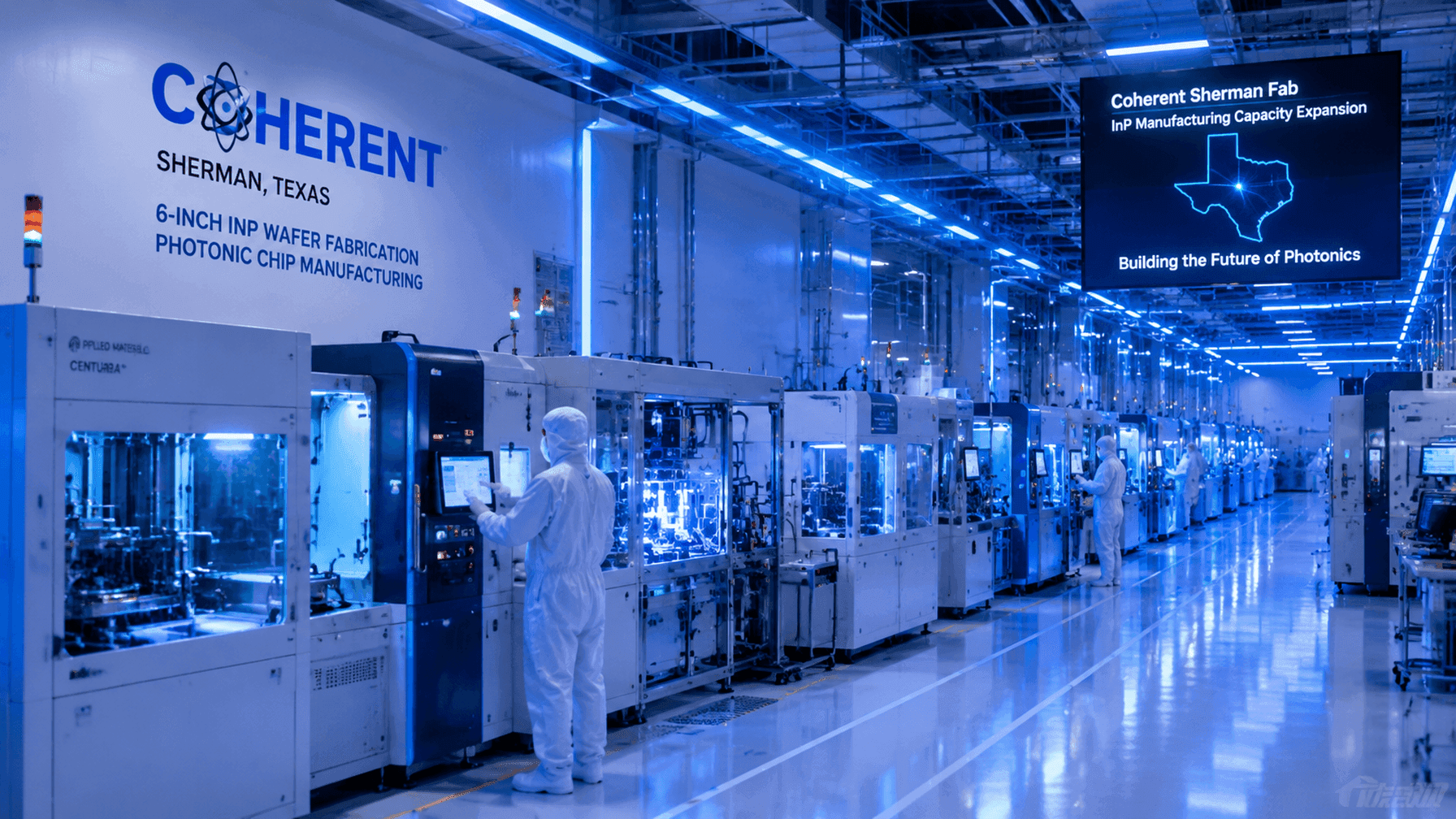
Coherent broke ground on an expansion of its six-inch indium phosphide (InP) semiconductor fab in Sherman, Texas, in June — a ceremony Huang attended personally. The U.S. Department of Commerce separately committed up to $50 million in CHIPS Act funding to the project, which will double manufacturing space and quadruple wafer output.
Nokia is expanding photonic chip testing and packaging capacity at its Allentown, Pennsylvania facility tenfold by Q3 2026, using InP technology acquired through its Infinera purchase. The company claims its latest coherent optical line systems deliver 70% lower total cost of ownership versus prior-generation equipment.
The hardest constraint may be substrate supply. JX Advanced Metals, one of only two companies globally that produce InP substrates at commercial scale, has announced plans to invest up to 120 billion yen over four years to expand production capacity seven to ten times. InP — indium phosphide — is the semiconductor compound underlying most high-speed optical transceivers, and its supply chain has fewer players than either GPUs or HBM memory.
What the Numbers Signal
Optical components already account for an estimated 15-20% of total AI cluster cost, up from roughly 5-8% three years ago. That figure is set to rise as CPO integration moves optical switching from the cage on the front of a rack to inside the chip package itself — increasing content per GPU while reducing the total modules required.
For data center operators, the implication is that their vendor relationships in optics matter as much as their GPU allocations. Hyperscalers with existing supply agreements with Coherent or Lumentum are better positioned for Vera Rubin deployments than those sourcing on spot markets. Meta, which operates clusters of 50,000 or more GPUs, has been a major buyer of 800G optical modules; the transition to 1.6T transceivers required for Rubin-generation clusters will stress supply further.
The secondary constraint is InP substrate availability. JX Advanced Metals and rival AXT are both ramping, but substrate expansions take two to three years to come online — meaning demand from Feynman-generation deployments in 2028 will test whether the 2026 investment wave translates into actual atoms by then.
What to Watch
Track Coherent's fiscal Q4 earnings in August for its first revenue guidance tied to Nvidia purchase commitments, and watch whether Nokia secures a direct Nvidia supply agreement to join Coherent and Lumentum — its Allentown ramp suggests it is positioning to do so.
Source: pandaily, bloomberg_tech, dck_news, dcd_news, dc_frontier